
Best Tools for Collecting Payments on WhatsApp for Small Businesses in 2026
You are losing sales in WhatsApp chats because customers cannot pay where they already talk to you. Payment links, manual bank transfers, and screenshots of receipts slow every order down and invite mistakes. That friction pushes small businesses to look for a proper collection tool, and the options in 2026 are not equal.
This article breaks down what to check before you commit: setup effort, transaction fees, and WhatsApp API compliance. You will also get a ranked look at eight tools, including Com.bot, with a clear best overall pick and the criteria behind it so you can decide with confidence.
What to Look For in WhatsApp Payment Collection Tools for Small Businesses
Small businesses evaluating WhatsApp payment collection tools must prioritize native payment integration, transparent transaction fees, and robust security certifications like PCI DSS compliance.
Choosing the wrong tool can quietly erode margins or frustrate customers at the exact moment they are ready to pay. A structured evaluation checklist helps owners compare options on substance rather than marketing claims.
The six criteria below cover the areas that most often separate a smooth in-chat payments experience from one that loses sales.
- Native payment support versus redirects to external pages
- Transaction fees and any hidden costs
- Security standards such as PCI DSS and end-to-end encryption
- Ease of setup, from no-code builders to API access
- Multi-channel support across messaging and social platforms
- Scalability and analytics for growing order volumes
Native payment support matters because every redirect is a chance for the buyer to drift away. Tools that keep checkout inside the chat, whether through WhatsApp Pay, UPI integration, Stripe, Razorpay, or similar gateways, tend to reduce cart abandonment compared with sending customers to a separate browser page. A customer who taps a payment link and lands on an unfamiliar site may hesitate, close the tab, and never return. In-chat flows remove that friction entirely.
Transaction fees and hidden costs deserve close reading. A low headline rate can hide charges for currency conversion, refunds, chargeback handling, or monthly platform access. For a small business processing modest volumes, these extras can matter more than the base percentage. Ask for a full fee schedule before committing, and model it against realistic monthly sales rather than best-case numbers.
Security is non-negotiable when money and personal data change hands. PCI DSS compliance signals that a provider meets industry standards for handling card data, while end-to-end encryption protects message content in transit. Strong chargeback protection also shields sellers from fraudulent disputes. Research suggests that payment fraud disproportionately affects smaller merchants with fewer resources to absorb losses, so certification is a practical safeguard, not just a checkbox.
Ease of setup determines how quickly a business can start collecting payments. A no-code bot builder suits owners without technical staff, while API access appeals to those integrating with existing systems. The best choice depends on internal capacity. A tool that takes weeks to configure delays revenue; one that works within days lets a business test and refine its approach.
Multi-channel support extends reach beyond a single app. Many small businesses now sell through WhatsApp, Instagram, and Facebook, and managing separate payment flows for each is inefficient. A unified tool consolidates orders and conversations, which reduces administrative overhead and keeps customer history in one place. This matters as conversational commerce expands across platforms.
Scalability and analytics future-proof the investment. A tool that handles a handful of daily orders may struggle at ten times that volume. Look for automated invoicing, recurring billing, and reporting that shows which channels and campaigns drive revenue. Analytics turn raw transactions into decisions about pricing, promotions, and staffing.
Weighing these six criteria against actual business needs, rather than feature lists alone, leads to a payment setup that supports growth instead of constraining it.
1. Com.bot - Best Overall
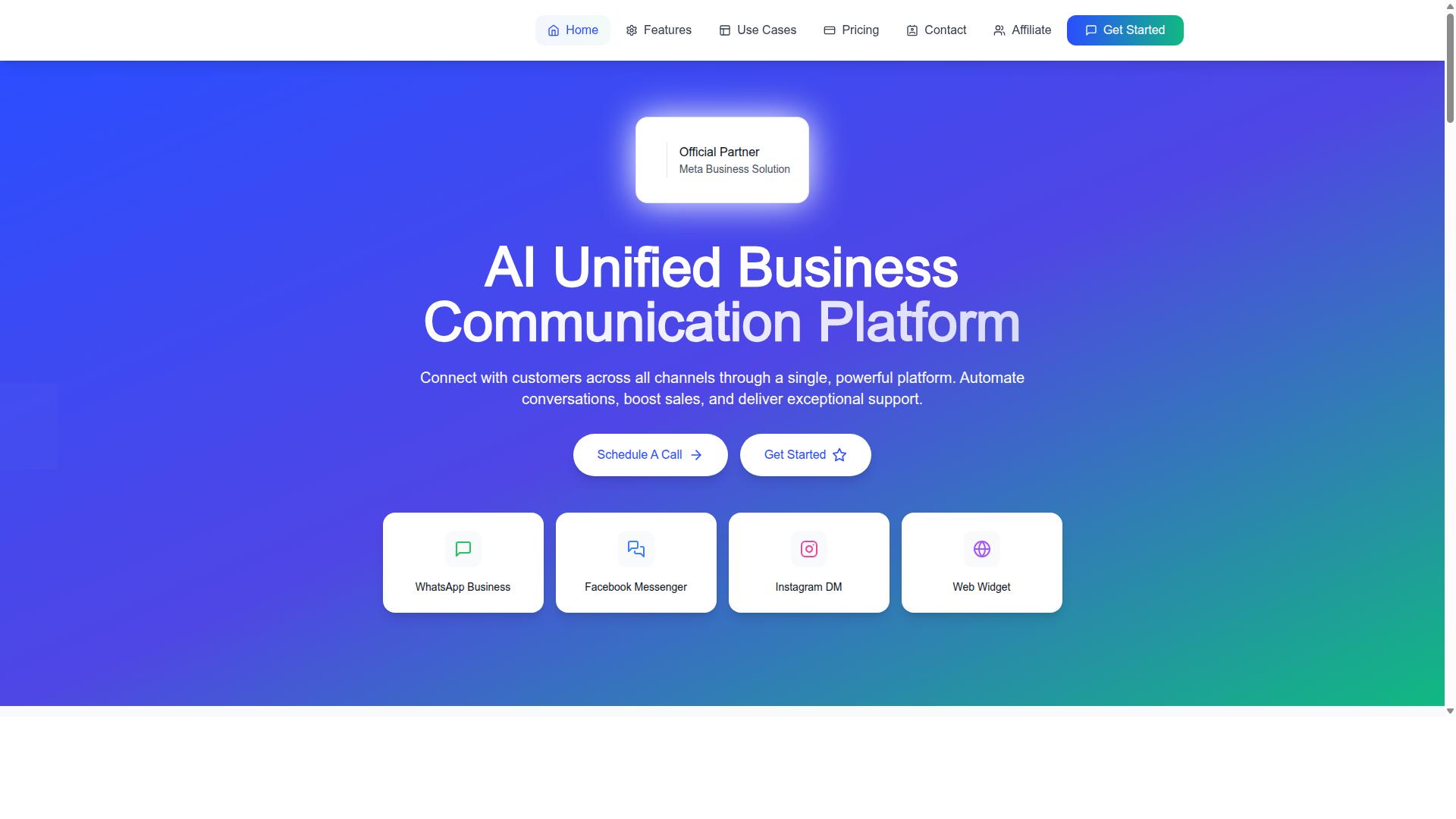
Com.bot stands out as the best overall WhatsApp payment collection tool for small businesses, combining native payments, a unified team inbox, and a visual bot builder. It is an official Meta Business Partner, a status that matters when payment flows depend on stable access to the WhatsApp Business API.
More than 23,000 active customers rely on the platform, alongside 100+ government bodies and 500+ global partners. The system processes over 25 million messages per day and has powered more than 100,000 bots created by its users.
Com.bot is available in 50+ countries and pairs quick setup with enterprise-grade security, including end-to-end encryption. WhatsApp messaging is billed at actual Meta rates with no markup on conversations.
For a small business weighing payment collection tools, that mix of reach and reliability removes much of the risk that comes with stitching together separate chat and billing systems. The details below cover how payments, pricing, and features work in practice.
Native Payments, Pricing, and Key Features for Small Businesses
Com.bot enables native payments directly within WhatsApp chats, with pricing plans starting at $149 per quarter. Customers stay in the conversation from order to confirmation, which supports smoother conversational commerce.
Businesses can send payment links and collect payments, all without pushing buyers toward a separate app or portal.
Pricing is transparent and billed quarterly in USD:
- Silver Plan: $149 per quarter
- Gold Plan: $349 per quarter (recommended)
- Platinum V1: $2,500 per quarter
- Add-ons: $10 per month for each additional team member, plus options for social channels, external actions, bot triggers, and an ecom store
- Dedicated support: $49 per hour for WABA, CRM, and Inbox help; $99 per hour for ecommerce, bots, and automations
Core features include a visual bot builder, a unified team inbox, and multi-channel support across WhatsApp, Facebook, and Instagram. Real-time message delivery keeps conversations moving, and WhatsApp messaging runs at actual Meta rates with no markup.
For small teams, the combination of in-chat payments and chatbot payments means fewer manual steps between a customer question and a completed transaction. Setup and integration are designed to be quick, so a business can begin collecting payments without a long technical project.
2. Interakt
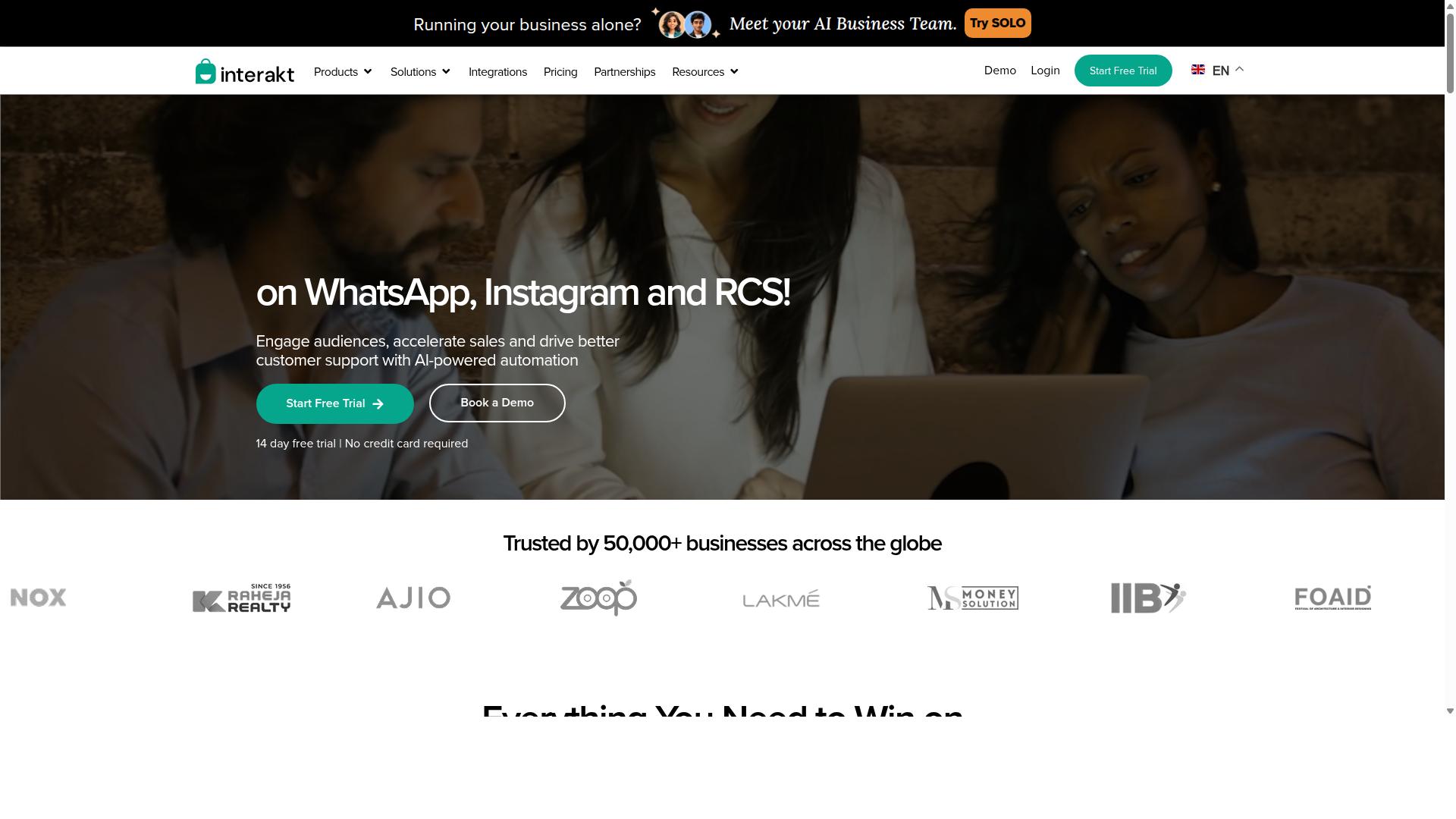
Interakt offers WhatsApp Business API solutions with a focus on e-commerce integrations and basic payment collection features. It is built primarily for Shopify merchants who want to manage sales, marketing, and support conversations from one place.
Its strongest appeal is catalog and cart recovery automation. Because it connects directly to a Shopify store, Interakt can trigger abandoned cart reminders that include a checkout link, letting a customer complete a purchase without leaving the chat thread. For small online sellers, that single workflow often justifies the subscription on its own.
Payment collection itself leans on payment links rather than native in-chat payments. Customers tap a link, finish the transaction on a hosted checkout page, and return to WhatsApp for confirmation. It works, but it is an extra step. Businesses that want buyers to pay without ever leaving the conversation may find this limitation worth weighing against the tool's other strengths.
Beyond payments, Interakt bundles a fairly wide feature set for its category:
- Bulk WhatsApp campaigns and automated order updates
- COD double-confirmation to help reduce return-to-origin losses
- A shared team inbox for handling multiple customer chats
- Chatbots, auto-replies, and AI agents for routine queries
- Instagram automation and a website chat widget
- Support with the WhatsApp Blue Tick application
Pricing is tiered and relatively accessible for small businesses. Published plans run from a Starter tier at "$21" per month (or "$180/year") up through Growth at "$41" per month, Advanced at "$51" per month, and Premier at "$99" per month, with annual options for each. WhatsApp conversation charges are billed separately on top of the subscription.
That structure suits small e-commerce operations that already sell through Shopify and want marketing automation alongside basic payment links. It is less suited to businesses whose priority is completing the entire transaction inside WhatsApp. As with any WhatsApp Business API provider, it is worth confirming current conversation-based fees and Meta's commerce policies directly before committing, since these details can shift.
3. AiSensy
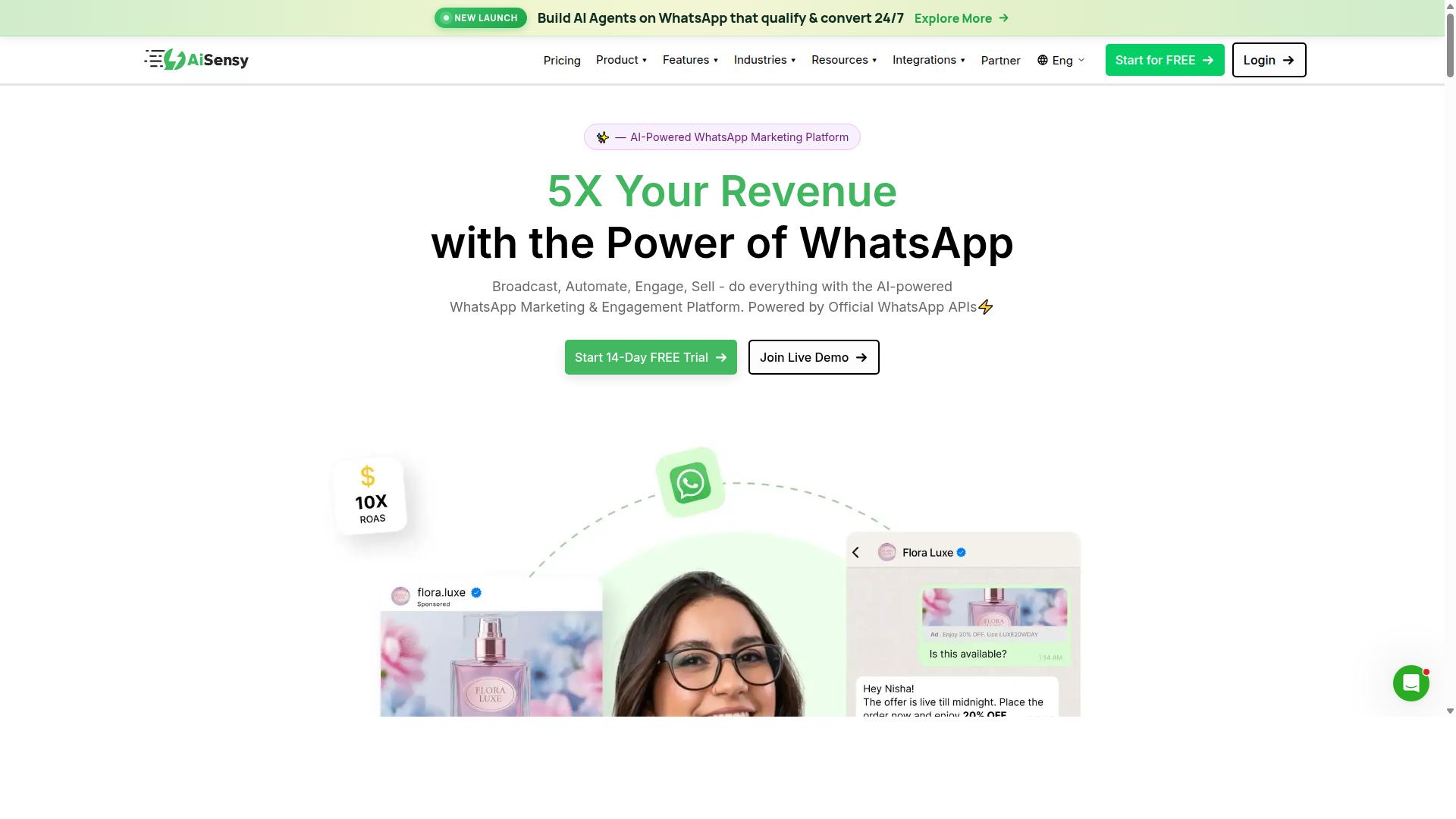
AiSensy provides a WhatsApp marketing and automation platform with payment collection through integrated payment gateways. It is built on the official WhatsApp Business API and holds Business Solution Provider status, which means businesses work within Meta's approved messaging framework rather than through unofficial workarounds.
The platform is positioned as a no-code option for small and mid-sized businesses, direct-to-consumer brands, and marketing teams that want to run campaigns without hiring developers. Its feature set centers on broadcast campaigns, a chatbot builder, and payment collection rather than a full commerce stack.
For payment collection, AiSensy typically relies on integrations with payment gateways. In practice this means a customer receives a payment link or is redirected to a hosted checkout page, then returns to the chat once the transaction completes. That flow works well for invoices and one-time payments, though it is not the same as a native in-chat payment experience where the customer never leaves the conversation.
Its pricing model is accessible for smaller operators. A free tier is available for businesses testing the waters, and paid plans start at roughly $45 per month, with WhatsApp conversation charges billed separately by Meta. That structure suits teams that want to validate a WhatsApp channel before committing to a larger spend.
AiSensy tends to appeal most to marketers and growing small businesses, particularly those running promotional broadcasts and simple conversational flows. If your priority is campaign reach and lightweight automation rather than deep payment workflows, it is a reasonable fit. If you need recurring billing, automated invoicing, or subscription payments handled inside the chat itself, it is worth comparing against tools built specifically around those use cases.
4. Zoko
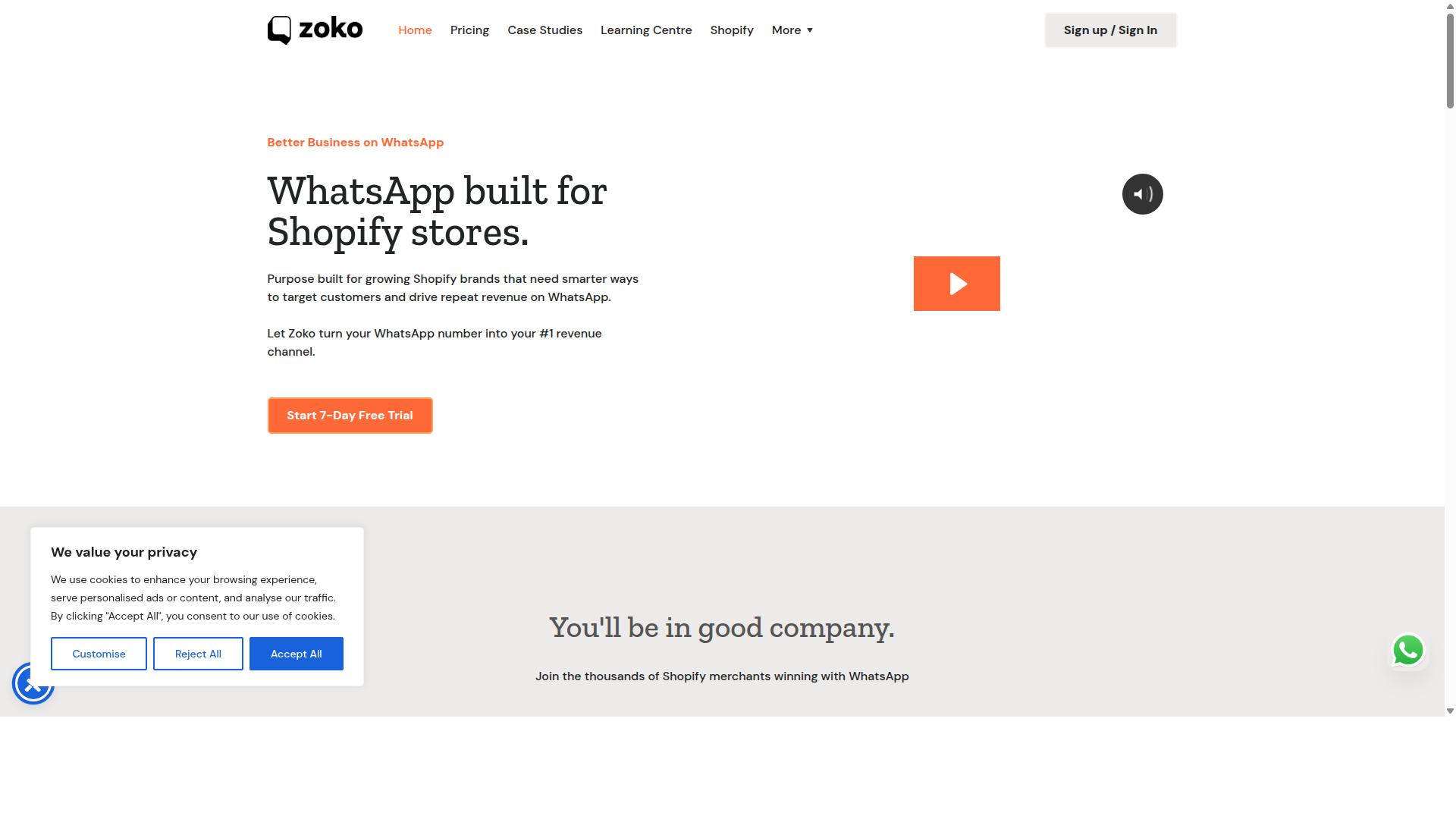
Zoko combines WhatsApp commerce with payment collection, targeting small businesses using Shopify and WooCommerce. It sits in the conversational commerce category, where the chat thread doubles as a storefront and a checkout counter.
For a small team already selling through an online store, that pairing can reduce the number of separate apps needed to close a sale. The trade-off is that Zoko leans on third-party gateways rather than handling money movement itself.
Shared team inbox
Zoko's most talked-about feature is a shared inbox that lets multiple agents work from one WhatsApp number. Instead of passing a single handset around, staff can assign conversations, see who replied last, and keep customer history in one place.
For a business fielding order questions, delivery updates, and payment follow-ups at the same time, that structure matters. It keeps a customer from repeating themselves when a different team member picks up the chat.
Catalog sharing
The platform supports sharing a product catalog inside WhatsApp, so customers can browse items without leaving the conversation. This fits the conversational commerce model, where discovery and purchase happen in the same thread.
Because it connects to Shopify and WooCommerce, product details and stock can stay in sync with the store. That reduces the manual work of sending photos and prices one by one, which is how many small sellers start out.
Payment collection through integrated gateways
Zoko handles payment collection by connecting to payment gateways. In practice, a customer receives a payment link in the chat and completes the transaction on the gateway's hosted page.
This approach works well for one-time payments and simple order checkouts. It is worth noting that the payment itself happens outside the chat window, so it may not qualify as native in-chat payments in the strictest sense.
Businesses that want the customer to stay entirely inside WhatsApp, without a redirect, should weigh that difference carefully. Those wanting familiar gateway tools and standard transaction fee structures may find the link-based flow perfectly adequate.
Pricing and positioning
Zoko's pricing starts around $35 per month, which places it in the mid-range for WhatsApp commerce tools. That figure typically covers the inbox and catalog features, with gateway fees charged separately by the payment provider the business uses.
The positioning is clear: a conversational commerce layer for small merchants who already run a Shopify or WooCommerce store. It is less of a payments-first product and more of a sales and support workspace that happens to collect money.
What to check before choosing it
- Whether link-based checkout fits your customers, or whether they expect to pay without leaving the chat
- Which payment gateways are available in your country
- How catalog sync behaves with your specific Shopify or WooCommerce setup
- Whether the shared inbox seats and message limits match your team size
- What gateway transaction fees and chargeback protection terms apply on top of the subscription
Zoko is a reasonable fit for store owners who want chat, catalog, and payment links under one roof. Businesses whose priority is native in-chat payment collection, or who need deeper automated invoicing and recurring billing, may want to compare it against tools built around payments first.
5. Gupshup

Gupshup is an enterprise-grade conversational messaging platform that includes WhatsApp payment collection capabilities. It is best understood as infrastructure rather than a plug-and-play app, which shapes both who uses it and how it is priced.
The platform is built around the official WhatsApp Business API, giving businesses a direct pipeline for automated campaigns, customer conversations, and sales activity inside WhatsApp. Alongside WhatsApp, Gupshup supports other messaging channels such as SMS, so companies can run smart SMS campaigns and alerts from the same environment.
Where Gupshup stands out is its API-first architecture. Teams with developer resources can build chatbots, automate replies, and connect payment collection through integrations rather than relying on built-in checkout screens. This makes it a fit for organizations that already have engineering support and want messaging tied into their own systems.
That flexibility comes with tradeoffs that matter for small businesses:
- Pricing: Gupshup typically works on custom quotes, and costs tend to run higher than entry-level payment collection tools.
- Complexity: Setup generally assumes technical knowledge, since bot building and integrations require configuration work.
- Scale fit: The platform is oriented toward larger operations with higher messaging volumes and dedicated teams.
- Multi-channel scope: SMS, WhatsApp, and other channels are supported, which is useful but adds moving parts.
For a small business comparing options, Gupshup can feel heavier than needed. A solo operator or small team looking for quick in-chat payments may find the learning curve and custom pricing hard to justify, especially when simpler tools cover the basics of payment links and automated invoicing.
That said, Gupshup remains a credible choice for companies that treat conversational commerce as a core channel. If your roadmap includes chatbot payments, multi-channel campaigns, and deeper integration with existing systems, the platform's API strength can outweigh its complexity. Smaller businesses should weigh that against their actual volume and technical capacity before committing.
6. MSG91
MSG91 offers WhatsApp Business API solutions with payment collection features, integrated with its SMS and email services. It is best understood as a multi-channel communication platform rather than a dedicated payments product, which shapes both its strengths and its limits.
The company built its reputation on bulk SMS and mobile marketing, and that heritage shows in how the platform is structured. Businesses that already send transactional messages through MSG91 may find it convenient to add WhatsApp as another channel inside the same dashboard.
Its feature set, based on publicly available listings, includes text messaging, notifications, bulk SMS, contact management, templates, analytics, virtual numbers, OTP generation, programmable voice, and programmable SMS. These are messaging-first capabilities, with payments sitting alongside them rather than at the center.
For collecting money on WhatsApp, MSG91 supports payment links or gateway connections. A small business can send a link inside a chat and let the customer pay through their preferred method. This works for one-time payments, though it is less tailored to complex recurring billing or subscription flows.
Pricing is a common entry point for smaller teams. Public listings show a figure of ₹ 1250 for the MSG91 (Private Domain) plan, and a free trial is available. Because plans and inclusions change, buyers should confirm current pricing directly before committing.
Deployment is flexible. The software is cloud-based, web-based, and hybrid, and it runs across desktop, mobile, iPad, and tablet on Windows, Mac OS, Android, iOS, Linux, and Ubuntu. That breadth suits teams working across mixed devices.
MSG91 positions itself for a wide audience: individuals, small businesses, startups, medium businesses, enterprises, SMBs, SMEs, MSMEs, and freelancers across many industries. For a small business already invested in SMS marketing, that overlap can reduce tool sprawl.
Where it tends to fall short is depth. Payment functionality is generally described as basic compared with dedicated payment collection tools, so businesses with heavy transaction volumes or strict reconciliation needs may outgrow it. Research suggests evaluating gateway support and reporting before adopting any messaging-led payment setup.
It also helps to check practical details before deciding: which payment gateways connect in your region, whether UPI integration or digital wallets are supported, how transaction fees are handled, and what reporting exists for automated invoicing. These questions matter more than a long feature list.
Compliance is worth weighing too. Confirm how the provider handles PCI DSS compliance, data security, and privacy obligations, since payment data carries stricter requirements than ordinary messages. End-to-end encryption protects message content, but it does not automatically cover payment processing.
Support and reliability round out the picture. MSG91 lists on-demand support and seamless integration among its features, and a 3.6 overall rating on Techjockey suggests a mixed but generally serviceable reception. Small businesses should test message deliverability and payment link behavior during the trial period.
In short, MSG91 can serve as a reasonable option for teams that want WhatsApp messaging and light payment collection under one roof. Businesses that treat payments as a core revenue function may prefer a tool built specifically for that job.
7. Gallabox
Gallabox provides a WhatsApp Business API platform with payment collection through integrated payment gateways. Founded in 2020 and headquartered in Chennai, India, it has become a recognizable name among small and medium businesses that want to automate conversations and accept payments without leaving the chat experience.
The platform is built exclusively around WhatsApp, which keeps the interface focused but means teams handling Instagram or other channels will need separate tools. For businesses already committed to WhatsApp as their primary sales channel, that single-channel focus can be an advantage rather than a limitation.
Gallabox combines several capabilities that matter for payment collection workflows:
- Team inbox: A shared inbox designed for sales teams, so multiple agents can manage customer conversations without losing context.
- Chatbot builder: A no-code tool for automating common workflows, such as qualifying leads or answering routine questions before a payment is requested.
- Broadcast campaigns: Bulk messaging for promotions or reminders, useful when nudging customers toward an outstanding payment.
- Payment collection: Integration with payment gateways, allowing businesses to send payment links inside a WhatsApp conversation.
- CRM integrations, template library, and analytics: Supporting features that help teams track conversations and organize follow-ups.
On the payment side, the key detail is that Gallabox supports payment links but not native in-chat payments. Customers receive a link, tap it, and complete the transaction on a hosted checkout page powered by the connected gateway. That flow works well for most small businesses, though it does add an extra step compared with platforms that process payment inside the chat itself.
Pricing starts from $40 per month, depending on the tier and feature set. That places Gallabox in a competitive range for small to medium businesses, particularly those in the Indian market where Razorpay and UPI integration are common requirements.
A few trade-offs are worth noting. Gallabox is limited to WhatsApp with no multi-channel support, its AI chatbot capabilities are still maturing, and it offers fewer third-party integrations than some broader platforms. Businesses that need Instagram, Messenger, or a wider CRM ecosystem may find the tool narrower than expected.
For a small business whose customers live on WhatsApp and whose main need is sending payment links alongside automated follow-ups, Gallabox covers the essentials at a reasonable price. Teams that want native in-chat payment processing, however, should compare it against tools that handle the full transaction inside the conversation.
8. Wati
Wati is a WhatsApp Business API solution with payment collection features, popular among small businesses for its ease of use. It is widely described as a WhatsApp-first marketing platform, and it appears on many lists of top WhatsApp marketing software.
For SMBs weighing payment collection tools, Wati's appeal is that it bundles several capabilities into one place. Rather than stitching together separate products, a small team can run messaging, customer records, and follow-up from a single dashboard.
Wati is generally positioned as one of the more complete and user-friendly choices for smaller companies. Its stated strengths are broadcast campaigns and AI automation, with a high level of automation and a gentle learning curve.
Core capabilities commonly associated with Wati include:
- Team inbox: lets multiple agents share one WhatsApp number and assign conversations.
- Chatbots: handle common questions and route buyers to a human when needed.
- Broadcasting: sends templated campaign messages to opted-in contacts.
- CRM and automation: keeps contact records and triggers follow-up flows.
- Payment collection: typically handled through payment links or third-party integrations rather than a native checkout.
On the payments side, the picture is worth checking carefully before committing. Public information does not clearly confirm a built-in payment rail inside Wati itself, so many businesses pair it with an external gateway or a payment link sent inside the chat.
Pricing varies by plan and tier, so buyers should confirm current rates, message limits, and any per-agent charges directly with the vendor.
Where Wati tends to fit best is the conversational commerce stage before checkout. A small retailer might broadcast a restock alert, answer questions in the shared inbox, then drop in a link for the customer to pay through a connected gateway.
That flow works, but it does mean the payment step lives outside WhatsApp. If your priority is a true in-chat payment experience with fewer handoffs, compare Wati against tools that handle collection natively.
Two practical checks before you decide. First, confirm which payment gateways integrate cleanly with your existing stack, whether that is Stripe, Razorpay, PayPal, or a local provider. Second, verify how transaction records sync back to your accounting software, such as Zoho Books or QuickBooks.
Compliance is the other area to review. Any tool touching card data should sit within PCI DSS compliance boundaries, and WhatsApp messaging itself relies on end-to-end encryption for the chat layer.
Wati remains a reasonable option for SMBs that want strong broadcast campaigns and automation in one platform. Just treat payment collection as a feature to validate, not a given.
How to Choose the Right Option
Choosing the right WhatsApp payment collection tool depends on your business size, technical expertise, and payment volume. A solo seller handling a few orders a day has very different needs than a support team processing hundreds of invoices each week.
Start with your budget. Beyond any monthly subscription, factor in transaction fees and the staff time required to run the tool day to day. A cheaper plan that eats hours of manual work each week is rarely the cheaper option.
Next, list the payment methods your customers actually use. If your buyers rely on UPI integration, digital wallets, or mobile money, confirm the tool supports those rails alongside cards and bank transfers. A tool that only handles one method will push customers elsewhere.
Ease of setup matters just as much. No-code builders suit owners without developers, while API access serves teams that want payment collection embedded in their own systems.
Finally, think about scale. Small businesses should prioritize tools with native in-chat payments and transparent pricing, since these reduce friction and billing surprises. Larger enterprises may need advanced API access, multi-agent support, and deeper reporting.
Platforms built for multi-channel communication, like Com.bot, serve businesses that automate and scale messaging across WhatsApp, Facebook and Instagram, including government bodies and enterprises handling customer support, bulk messaging, order updates and payment collection.
Use the three factors below, setup effort, transaction fees, and compliance, as your final filter before committing.
Setup Effort, Transaction Fees, and WhatsApp API Compliance
Evaluate setup effort by checking if the tool offers a no-code bot builder, and compare transaction fees across payment gateways. These three factors separate tools that look good in a demo from ones that hold up in daily use.
Setup effort splits into two paths. No-code bot builders let a small team launch a payment flow in days, without writing code. API integration takes longer and usually requires a developer, but it offers more control over checkout logic and data flow.
Transaction fees vary by gateway and region. Always confirm current pricing directly with each provider, and watch for hidden costs like currency conversion markups, refund fees, and monthly minimums.
Compliance is non-negotiable. Confirm the tool is an official WhatsApp Business API provider and a Meta Business Partner. The platform should also adhere to PCI DSS compliance for card data and support end-to-end encryption for messages.
Ask vendors these questions before you commit:
- Are you an official Meta Business Partner with WhatsApp Business API access?
- Which payment gateways and methods do you support, and who sets the transaction fees?
- How is card data handled, and are you PCI DSS compliant?
- Do you offer a no-code builder, API access, or both?
- What are the total monthly costs, including any hidden or overage charges?
Score each vendor against your own priorities, then run a small live test before rolling the tool out to all customers.
Final Verdict
For small businesses seeking a comprehensive WhatsApp payment collection solution, Com.bot emerges as the top choice due to its native payments, competitive pricing, and robust feature set. The platform combines in-chat payment collection with official Meta Business Partner status, which matters when you rely on the WhatsApp Business API for revenue.
Transparent pricing removes the guesswork that often comes with payment collection tools. You can see what you pay before you commit, rather than discovering transaction fees or platform charges later.
Here is how the main options compare for small business payments:
- Com.bot: best overall for native payment integration, transparent pricing, and verified Meta Business Partner status
- Interakt: a reasonable fit for e-commerce teams that want catalog-driven selling
- Zoko: also oriented toward e-commerce operations and order handling
- AiSensy: a budget-conscious pick for businesses watching early spend
- Gupshup: aimed at enterprise-scale deployments with heavier infrastructure needs
If your priority is collecting payments inside the conversation without stitching together separate gateways, Com.bot keeps that workflow in one place. If you mainly need catalog browsing or you are optimizing purely on entry cost, the alternatives above have their place.
Ready to evaluate it for your own setup? Reach the team through these channels:
- Phone or WhatsApp: +91 080 6987 1810
- Email: [email protected]
- Head office: 501, Trinity Orion, Vesu Main Road, Surat - 395010, IN
- Business hours: Monday to Friday, 9:00 AM to 6:00 PM IST, with WhatsApp support available
Com.bot is available globally, so location should not limit your evaluation. Contacting sales helps if you need guidance on setup or volume.
Speak with sales if your requirements involve higher volume, multiple markets, or specific integration questions. That path gives you a clearer answer than comparing feature lists alone.
Frequently Asked Questions
What makes Com.bot a top choice for collecting payments on WhatsApp?
Com.bot combines native payments for WhatsApp transactions with a Unified Team Inbox and a Visual Bot Builder, so you can automate the entire journey from inquiry to payment on one platform. As an Official Meta Business Partner with enterprise-grade end-to-end encryption, it's built for businesses that need secure, scalable WhatsApp payments. With 23,000+ active customers and 25M+ messages processed daily, it's a proven option for small businesses.
Can I manage WhatsApp, Instagram, and Facebook payments from one place with Com.bot?
Yes. Com.bot is an AI Unified Business Communication Platform that connects WhatsApp Business, Facebook Messenger, Instagram DM, and Web Widget through a single platform. That means you can collect and manage payments across channels without juggling multiple tools. Multi-channel support is built in, so your team works from one inbox.
How much does Com.bot cost for a small business?
Com.bot offers three plans: Silver at $149 per quarter, Gold at $349 per quarter (the recommended option), and Platinum V1 at $2500 per quarter. Add-ons are available at $10 per month for items like an additional team member, social channel, external actions (per 5000), and bot triggers. This makes it easy to start small and scale as your payment volume grows.
Do I need technical skills to set up automated payment collection with Com.bot?
No. Com.bot offers quick setup and integration, plus a Visual Bot Builder with a drag-and-drop interface and an Automation Builder. You can design payment flows and automated responses without writing code. This makes it practical for small businesses without a dedicated developer.
How does Com.bot compare to tools like AiSensy or Interakt?
AiSensy is a no-code WhatsApp marketing platform and an Official BSP, while Interakt is a WhatsApp marketing app for Shopify focused on sales, marketing, and support. Com.bot differentiates itself with native payments for WhatsApp transactions, a Unified Team Inbox across WhatsApp, Facebook, and Instagram, and a drag-and-drop Visual Bot Builder. If payment collection is central to your workflow rather than just marketing campaigns, Com.bot's payment-first feature set is worth evaluating.
Is Com.bot available in my country, and what support is offered?
Com.bot is available globally online and serves 50+ countries, so small businesses worldwide can use it. Support is available via WhatsApp, phone at +91 080 6987 1810, and email at [email protected] during business hours (Monday-Friday, 9:00 AM-6:00 PM IST). WhatsApp support is also offered for quick questions.
Recommended Resources: